 Index
Index

Australia is a land of wonder where visitors can explore the wilderness of the continent and dive into the magical splendor of the great barrier reef. Canberra, the capital, and Sydney are the biggest cities in New South Wales which is Australia's most populous and oldest state. New South Wales is also the location of the picturesque Blue Mountains.


Sydney
Sydney is a beautiful modern city with approximately 4.4 million inhabitants,
a rich history, a dynamic way of life, and world-famous tourist attractions waiting to be explored.
The Opera House and the Harbour Bridge are landmarks of international renown.
The Sydney Opera House with its distinctive architecture is open for tours daily.
Walking paths lead toward the city center through the
Royal Botanic Gardens which are open from sunrise to sunset. The gardens feature an attractive
collection of plants, beautiful paths, places to picnic, as well as a restaurant.
The Sydney Harbour Bridge links the center to the suburbs and
carries eight lanes of road traffic and two railway tracks.
The bridge has a challenging pedestrian climb over the
arch at 134 meters above sea level.
The Sydney Aquarium is one of the world's best. It has over 150 meters of clear
tunnels that enable visitors to see fish swimming around and overhead. Native Australian
species, such as the platypus, are displayed.
The Museum of Applied Arts and Sciences in Sydney features the historic Sydney Observatory
and the Powerhouse Museum which has a diverse collection of decorative arts, science,
transport, computer technology, and space technology.
;w1.focus() "Sydney Opera House")

Many things about Australia are similar to the United States because they both started out as British colonies. Even the modern economic development has many parallels. Multinational corporations have found it easy to use paradigms that were successful in the United States and adapted them for Australia. McDonald's restaurants are identical in both countries, but Burger King is called Hungry Jack's in Australia. Sydney also has Westfield shopping centers, Target stores and 7-Eleven convenience stores. The electricity is 220 volts, 50 cycles per second, and the plugs have tilted prongs.

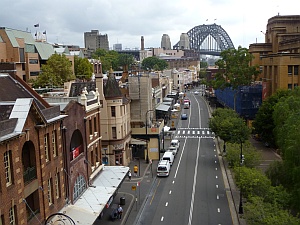
Sydney is a city with an international character due to the large number of Asian immigrants that have become residents of Australia. Throughout the city there are many Vietnamese and Chinese restaurants, bakeries, and shops. In some suburbs, shops with signs in Arabic offer halal meats and middle eastern products. Many different languages can be heard while walking in the center of the city. The Rocks is a historical quarter where Europeans first settled in Australia.
Some of the attractions in Sydney are Market City and Bondi Beach. Market City is four blocks away from Central Station. Bondi Beach can be reached by bus from the Bondi Junction train station. A ferry from the Circular Quay station provides transportation to the Taronga Zoo. Market City is in Chinatown. As the name implies, Market City is a large complex of shops offering a variety of goods such as clothing, hats, swimwear, toys and souvenirs. This should be one of your first stops if you forgot to bring something when you packed your suitcases. You are sure to find it here. If you get hungry while shopping, just cross the street to find many Chinese restaurants. The Cabramatta suburb has a large concentration of Vietnamese, Thai, and Chinese shops and restaurants. Some of the Vietnamese refreshment shops sell freshly squeezed sugar cane juice and other traditional fruit-flavored drinks with tapioca beads.


The streets of Sydney are busy, but orderly. Cars drive on the left side of the road. Parking is expensive and difficult to find. It may cost $35 Australian Dollars to park close to the wharf and opera house. Public transportation is reliable; it uses electric trains, buses, and ferry boats. A one-week pass for $48 Australian Dollars is a good way to get around the city using any of these three modes of transportation. The Circular Quay station is near the picturesque bridge and opera house. This station is adjacent to the wharf where ferries travel to various points in the bay and provide a maritime perspective of the opera house and the Sydney skyline.
Sydney is the starting point for many trips to Australia. From there, you not only have the historical landmarks and tourist attractions of Sydney to explore, but, ultimately, all of Australia. South Wales provides a great introduction to the culture and ammenities that the continent has to offer. Australia is truly a vast and unique place, there are plenty of exciting new cities to see (such as the capital) and a number of smaller towns for you to get a feel of rural life and take in the majestic scenery.


The Taronga Zoo is situated on a hilly landscape with a maze of paths leading to the different animal exhibits. The zoo has African lions, Indian elephants, tropical birds, and native marsupials like koala bears, kangaroos, and wallabies. Take good walking shoes when you go to the zoo; you will need them.
Bondi Beach is the closest beach to Sydney. As in many resorts, luxurious apartments in the hills overlook the beach. A building across the lifeguard station has public restrooms where people can change into bathing suits. Along the street parallel to the beach, there are many restaurants where tourists can get food and refreshments. New Town is an old suburb of Sydney that is being restored. Old buildings with architecture reminiscent of the 1930's have been cleaned up, repainted, and put back in commercial use. The New Town area has many ethnic restaurants, bars, and stores that carry a wide variety of products from clothing to hardware.


The Blue Mountains
In November 2000, the Blue Mountains were declared a World Heritage
park. It was nominated for its outstanding natural values, including the
biodiversity of its plant and animal communities, its vegetation, which is
dominated by Australia's unique eucalyptus trees, and for the beauty of its natural
landscapes. The region offers a myriad of activities for the visitor like
bush walking, browsing for antiques, and adventures through limestone caves.
The Blue Mountains National Park is approximately 85 kilometers west of Sydney. The city of Katoomba is in the center of the park and close to the Scenic World amusement park and the Three Sisters, a mountain formation consisting of three adjacent peaks. The best vantage point for viewing the Three Sisters is from the Echo Point park overlook in the city of Katoomba. The Scenic World amusement park has several trails in the valley where the coal-mining history of the region is described. From the trails, visitors can get a close look at the magnificent vegetation of the Blue Mountains.
Australian Legends
For many generations, aborigines have told the legend of the
three sisters 'Meehni', 'Wimlah', and 'Gunnedoo', who lived in the Jamison
Valley as members of the Katoomba tribe. These beautiful young ladies had
fallen in love with three brothers from the Nepean tribe, but tribal law
forbade them to marry. The brothers defied this law and
decided to capture the three sisters by force causing a major tribal
battle. As the lives of the three sisters were seriously in danger, a
witch doctor from the Katoomba tribe used a magic spell to turn the three
sisters into stone to protect them from any harm. He had intended to
reverse the spell when the battle was over, but the witch doctor himself was
killed. As only he could reverse the spell to return the ladies to their
former beauty, the sisters remain in their magnificent rock formation as a
reminder of this battle for generations to come.
Jenolan Caves
The Aboriginal name for the Jenolan Caves was Binnomea which means "dark
places". The beauty of the Jenolan Caves is its maze of ancient limestone
tunnels, subterranean rivers, and caverns richly draped with exotic mineral
deposits. The caves were created over millions of years through a complex
relationship between water, rock, atmosphere, and the life forms that inhabit
the environment. The Jenolan caves are Australia's most
impressive limestone caves.
;w1.focus() "Uluru (Ayers Rock)")
Uluru (Ayers Rock)
Uluru, also known as Ayers Rock, is one of Australia's best known natural wonders in the Northern Territory,
approximately 465 kilometers south west of Alice Springs. The name Uluru is the name given to the mountain
by the Pitjantjatjara aborigines.
This 3.6 kilometer-long rock formation in Uluru-Kata Tjuta National Park rises 348 meters above the
surrounding desert. Uluru is made of coarse-grained arkose, a type of sandstone containing feldspar
that reflects a red glow at sunrise and sunset.

Melbourne
Melbourne is Australia's second largest city with a population of 3.9 million people.
It is expected that Melbourne will be the most populous city in Australia by 2028 due to its rapid growth.
Melbourne was transformed into a wealthy metropolis when gold was discovered in the area during the 1850s.
Today, Melbourne is a center for commerce, industry, education, arts, sports and tourism.
The population of Melbourne grew by an influx of immigrants and the prestige of hosting the Olympic Games in 1956.
Melbourne is a city teeming with activity and many remarkable tourist attractions.
You can ride the free City Circle Tram service to most of the main attractions in Melbourne.
A favorite stop is the Exhibition Gardens which features a collection of many of the unusual plants native to Australia.

Brisbane
Brisbane is the third largest city in Australia and the state capital of Queensland.
Brisbane's metropolitan area has a population of around 1.6 million people.
The city is situated along the Brisbane River and provides a picturesque setting with many riverside attractions, including
late night river cruises.
Brisbane has a subtropical climate with temperatures ranging between 20 to 29°C (68-84°F) in summer and cool temperatures
from 9 to 20°C (48-68°F) in winter. The Queen Street Mall features world-class shopping and the South Bank Parklands
provide a great place to have lunch.

The picture above shows an air view of the Great Barrier Reef across the city of Mackay on the eastern coast of Queensland, Australia, about 970 km (603 mi) north of Brisbane. The region around Mackay produces over one third of Australia's cane sugar. The Great Barrier Reef stretches for 1,750 kilometers (1,087 miles) between Brisbane at the southern boundary and Cairns at the northern boundary. It has hundreds of islands and thousands of individual reefs in the Coral Sea, off the coast of Queensland in northeast Australia. The reef supports a wide diversity of sea creatures such as corals, mollusks, sponges, worms, crustaceans, echinoderms (starfish), and an immense variety of other life forms. Australia's seashores have many stromatolites which are fossilized deposits of ancient cyanobacteria that lived 3,450 million years ago.
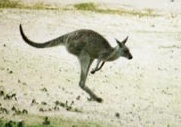
Australia is the home of many marsupials such as wombats, kangaroos, and Tasmanian devils. Marsupials are mammals that have a distinctive pouch in which females carry their young through early infancy. The kangaroo offspring, called joeys, stay in their mother's pouches for about ten months. Adult kangaroos can reach speeds of up to 35 miles per hour and leap up to 25 feet in a single bound.
In the Indonesian islands, Australia is called Benua Australia, and in Slovenian it is called Avstralija.





